
Growing up as a third generation Jewish Utahn, I played pickup baseball, aka “Wardball,” with neighbors who were members of the Church of Jesus Christ of Latter-Day Saints (formerly known as Mormons). These archetypically clean-cut, well-mannered, and devout LDS friends showed a more unvarnished side of themselves, throwing elbows and shouting words that they might not otherwise use. Many became classmates, colleagues, and even my best friends.
Today, I am CEO of the Jewish United Fund of Utah, and those friends are now partners in dialogue and collaboration – especially when it comes to the safety and security of faith communities across the state.
With 6.9 million Latter-Day Saints members across the country and 17 million around the world, it is a growing community with a particularly strong presence in the southwest. They are adherents of the first uniquely American religion, with an origin story entwined with religious movements of Upstate New York that grew alongside America’s westward expansion. Yet the Church of Jesus Christ of Latter-day Saints remains full of dynamism.
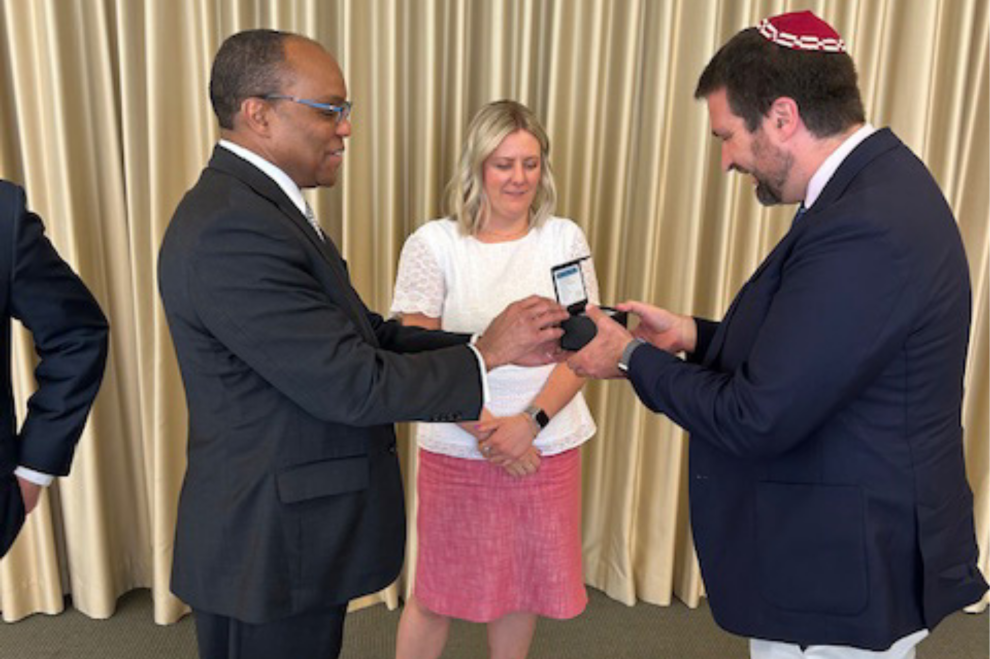
A couple of months ago, Rabbi Joshua Stanton, Associate Vice President for Interfaith and Intergroup Initiatives of the Jewish Federations of North America, visited me in Salt Lake City. Together, we took time to meet various LDS leaders, notably Elder Ahmed Corbitt, who oversees the Church’s external relations, and his colleague, Jonathan Ammons, who coordinates its interfaith relations.
Both affirmed several important, and newer, Church decisions: it no longer intentionally proselytizes to Jews, no longer proselytizes during interfaith dialogue and outreach, and has extensive agreements to this effect already in place with the Israeli government. Instead, the Church is interested in shared volunteer opportunities, disaster relief – including in Israel – and has an ethic of service which accounts for disproportionate representation in law enforcement and the military.
This dedication to service was evident the next day when the United Jewish Federation of Utah hosted its fourth annual Interfaith Security Symposium in collaboration with the Utah Department of Public Safety, at the Jewish Community Center in Salt Lake City.
Of the 150 participants, half (or more) came from federal, state, and local law enforcement – and many of those were active members or lay clergy in the Church of Jesus Christ of Latter-day Saints. It was unclear if they attended as faithful Church members, law enforcement or, most likely, both. They eagerly joined with representatives from Jewish, Muslim, Hindu, Evangelical, Mainline Protestant, and Catholic communities – all of whom felt a common sense of need to protect houses of worship from acts of hate.
This symposium built on earlier successes of building bridges through shared security interests, thanks to an Emergency Security Grant from Jewish Federations of North America, in partnership with The Tepper Foundation.
As they reaffirmed at the security symposium, Latter-Day Saints members feel the sting of hate crimes and have among the most extensive security apparatuses of any religious community. They also feel right at home with the Federation, its CEO, and its staff.
This comes from 15 years of groundwork that we laid through a Latter-Day Saint-Jewish Dialogue group 15 years ago. We meet bimonthly for lunch to discuss topics that are agreed to ahead of time.
Some conversations have been sensitive particularly around topics like posthumous baptism, proselytizing, antisemitism, and whether Judaism is more of a culture or religion (or both). With care, intention, and openness, this cohort of 20-30 people at any given time has sustained itself and shown love through acts of service to each other.
I remember vividly when the power went out at my synagogue 90 minutes before Rosh Hashanah services 8 years ago. Its new rabbi had little time to plan for contingencies. But he had built friendships with local Latter-Day Saint leaders. He called them, and before he knew it, they and a team of dedicated volunteers opened their Ward House (local Church gathering place), helped move all of the prayerbooks and a mobile ark, and joyfully hosted Rosh Hashanah services in their Church! That would probably only happen in a place like Salt Lake City, with friends from Latter-Day Saint communities.
Despite pervasive cultural stereotypes about Latter-Day Saint members, their missionaries, and their effusive kindness, those of us in Utah’s Jewish community know that they are wonderful neighbors. In attending to the security of Jewish communities, and actively sharing best-practices, Latter-day Saints in law enforcement and Church security are showing that they are sincere about building enduring friendships with us. We would do well to reach back.