By Carl Zebrowski
Editor
“Forty years ago a group of community leaders made a choice,” Dr. Zach Goldsmith, outgoing president of the Jewish Federation of the Lehigh Valley’s Maimonides Society told the crowd gathered at Temple Beth El on May 7 to celebrate the society’s 40th anniversary.
“They made a choice to start the very first Maimonides Society in America,” he said. He paused to ask the founders of the healthcare professionals organization to stand. “Thank you all for what you have built.”
A membership roster that started out with a few dozen names has changed quite a bit over the decades. “Today,” Goldsmith said, “the group has grown to more than 120 members.” Meanwhile, dozens of Jewish Federations across North America have been inspired to start Maimonides Societies of their own.
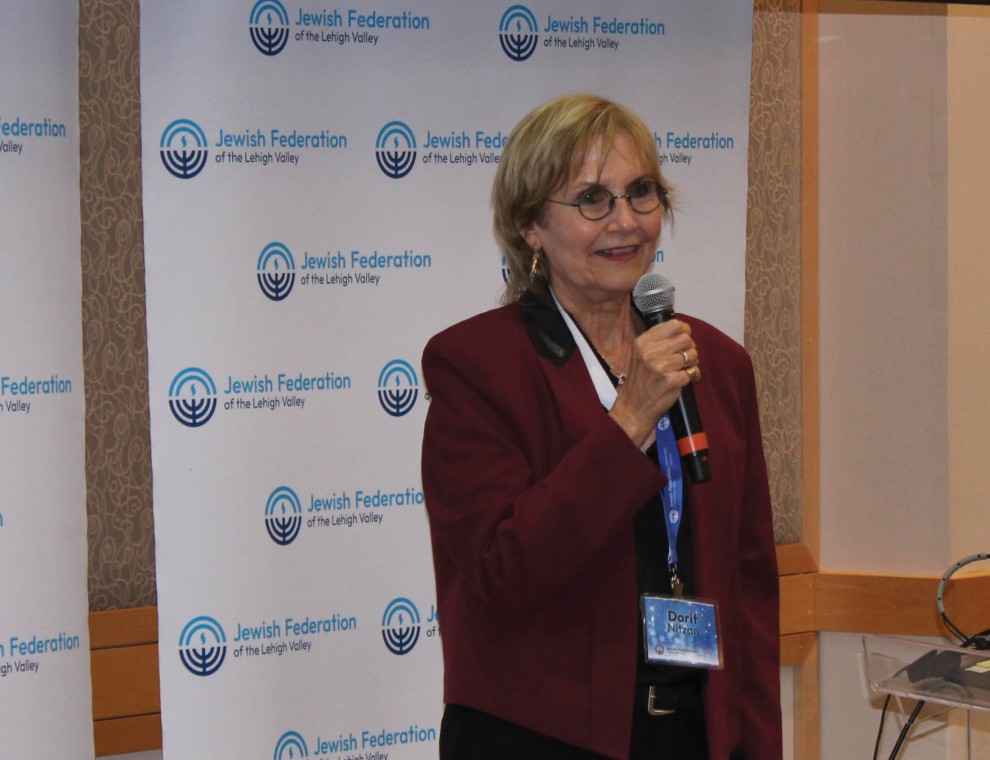
Dr. Bill Markson, president of the Federation, took the microphone to introduce the evening’s guest speaker. “As we reflect on the past 40 years,” he said, “it’s only fitting that we also turn our attention to the future.” He offered a brief background of Dr. Dorit Nitzan and said she’d speak on the topic “Building Health and Medicine Forward: Out- and In-the-Box Ideas.”
Nitzan immediately warmed up to the crowd. “I’m planning to call my home and say I found a new family and a new home,” she said, providing the audience with evidence that the advance word about her affability was on point. “If you want to sleep, try not to snore. I know you ate well.”
The healthcare professionals and other community members who came out to celebrate certainly did eat well. Much high praise for the food—laid out across tables categorized as Asian, Israeli, roast beef, turkey, etc.—was overheard as attendees returned to the stations for seconds.
Nitzan, director of the School of Public Health and head of the Master’s Program in Emergency Medicine at Ben-Gurion University of the Negev and former regional emergency director of the World Health Organization European Region (including Israel), gave some details of her background in healthcare at the regional, national, and global level. She told of how she left WHO to return to Israel after the October 7, 2023, Hamas attacks. “All the experience I had with emergencies in other parts of the world suddenly became concentrated for Israel,” she said.
Doctors from all over the world called to offer their help handling the emergency situation. “More than 700 doctors volunteered,” Nitzan said, “and 350 came and served for a few weeks. Each of the doctors got a shadow Israeli to help with the language, the computers, and everything. This is the Jewish solidarity that we pull out of the mud every time.”
Nitzan explained that in normal times, Israel’s healthcare system is very effective. “1994 was a remarkable year,” she said. That’s when the universal healthcare law was passed. “We care for each other,” she said, “all for all and always. All of us are insured, and those of us that work, we contribute more. No one has access more than the other.”
Statistics support her optimistic view. Life expectancy is 83.8 years in Israel, for example, 2.7 more than the Organization for Economic Co-operation and Development global average.
Still, innovation is needed. “We’re looking out of the box but also to stay in the box,” Nitzan said. Special attention must be paid to Israel’s underserved rural areas.
Ben-Gurion University partners with the Soroka Medical Center to serve Israel’s south, the Negev. One key focus there is what Nitzan called “homepital.” Experience has shown the efficiency and effectiveness of providing care for people at home. “This we started in Syria when I was there,” she said.
Treating patients in their homes “keeps them from having to go to Soroka, which is fully occupied at all times,” she said. Medical planners are also working to increase the number of mobile primary care units that travel out and about.
Technology is the most obvious area of continuous improvement. Among the many areas Nitzan detailed was the need for blood.
“Whole blood is a life saver,” she explained. “In order to save lives of wounded soldiers, we need to give whole blood, but blood is a very expensive commodity that we learned to appreciate when we have trauma.”
She suspected that AI will play a role in this. “The AI is running ahead of us, and we need to harness it to work with us,” she said. With AI’s help, artificial blood could be around the corner, more cost effective and more plentiful, and saving more lives.
Nitzan ended the evening by applauding the role of the Maimonides Society at this important milestone and thanking the members for all the good they have done over the decades for the Lehigh Valley community, for Jewish communities elsewhere in the world, and for Israel. And, by extension, all the good that has been done in the Maimonides Society name at other Jewish Federations that followed the Lehigh Valley’s lead.