By Naomi Schachter
Special to Hakol
There are moments when you feel called to show up not because it’s easy but because it matters. This is one of those moments. This April, for Yom HaShoah (Holocaust Remembrance Day), I participated with 7,000 others in the International March of the Living in Poland. Fifty Holocaust survivors ages 80 to 98 led the way from Auschwitz to Birkenau. I went to bear witness, to stand in the places where so many lives were stolen, and to honor their memory not just in silence but with presence, intention, and voice.
Before I left, people gave me names of family members murdered in the Holocaust. It was my honor and privilege to carry the names with me. I will say Kaddish for them in the camps. I held them in my heart as I walked. We are their voices. We remember. Always.
April 12. Krakow
My taxi driver tried to teach me Polish and gave me the word chrząszcz, beetle. I need a few more vowels. We both laughed the entire ride.
I wandered the city alone to get a feel for it. I had the chance to read a bit of the history of Poland and realized how little I knew before the 20th century. A country shaped by shifting borders, occupations, and resilience.
It feels warm and welcoming here. People love to laugh and share their favorite parts of the city they love so much. I definitely felt embraced.
Dinner turned into an unexpected moment of connection. The staff and other diners were so kind. Quince liquor was poured and passed around. The pierogis were incredible.
This is the normal, tourist part of the trip. And even as I allowed myself to enjoy it, I could feel myself bracing for what was coming.
April 13. Krakow, Jewish Quarter and ghetto
We walked through the Jewish Quarter and stood before the remnants of the Krakow Ghetto. Places that hold both unimaginable pain and enduring memory.
Before the Holocaust, Krakow was home to more than 200,000 Jews. Today there are about 1,500.
The ghetto, established in 1941, forced Jews into a confined area, cutting them off from the rest of society. Families were packed into small apartments. Food was rationed. Disease spread. Deportations began quickly, sending Jews to concentration camps and extermination camps.
Standing there, it became clear how systematic it was. It did not begin with killing. It began with separation, with language, with stripping people of identity and dignity.
And yet, within what remains, I saw something unexpected. There is a growing interest among Polish people in Jewish culture, music, food, and history. It felt like a quiet effort to remember, to rebuild, to acknowledge what was lost. Something fragile but real.
We ended the day with a moving ceremony, lighting candles for those murdered and those who survived.
What continues to humble me most is the spirit of Holocaust survivors. So many speak not with hatred, but with love. Not with revenge, but with hope. If they can still believe in humanity, then we must as well.
April 14, Yom HaShoah. March of the Living
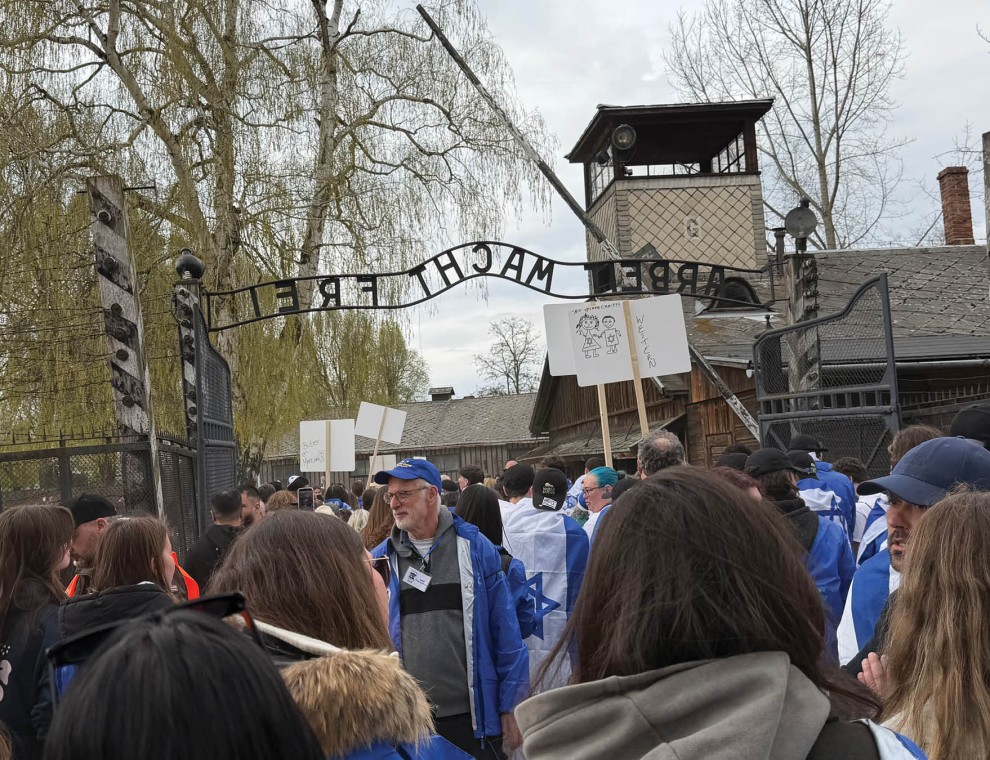
Today we walked from Auschwitz to Birkenau with nearly 10,000 people. I am still trying to process what it means to walk on that ground.
Auschwitz began as a concentration camp in 1940 and became part of a vast system. Birkenau was built for mass extermination.
The train tracks lead directly into the camp. Upon arrival, selections were immediate. Children, the elderly, many women, anyone deemed unfit for labor, were sent directly to gas chambers. Most were murdered within hours.
Zyklon B was used in chambers disguised as showers. Crematoria operated continuously. When they could not keep up, bodies were burned in open pits. There are no words that can hold what it feels like to stand there. To touch the barbed wire. To press your hand against the bricks. To stand where so many took their last breath. You are walking on hallowed ground. You feel it immediately. The air is not the same. Your body understands before your mind can process. You feel it in your bones, in every step, in the silence that somehow carries sound.
And yet, even there, I saw something else. I saw thousands of teens who showed up to remember, to carry the story forward. I met Mahmoud, a young Israeli Arab, who proudly told me he was the only Arab teen there. His presence, his pride, his joy, in a place built on hatred, felt like defiance. Like possibility.
I held a man from Bulgaria, the son of a survivor, as he broke down sharing his story. Two strangers, bound together in grief and memory.
Before walking through the arch, I placed the names entrusted to me in the ground between the railroad ties as an act of solidarity. I said Kaddish. For everything that was taken. For everything that will never be. And I cried.
A survivor said, “I was here, the gas chambers to the right and the crematorium was there on the left. And now I am here again. I am still here, and they are not.”
That is why we walk. We are here.
April 15. Auschwitz and Birkenau
Walking through Auschwitz, what struck me most was not only the brutality, but the calculated efficiency. Death was engineered. We saw rooms filled with human hair, approximately 80,000 pounds, taken from women and used for industrial purposes. Thousands of shoes, only a fraction of what was taken. The rest redistributed throughout Germany. Suitcases labeled with names. People were told to mark them so they would not be lost after their “showers.” The names were so carefully written so they would be easier to find. Even in their final moments, they were being deceived.
We saw standing cells where prisoners were forced to remain for days. Barracks where people were packed into impossible conditions. Execution walls. Numbers mattered. Not names. Not lives.
Then Birkenau. It stretches farther than the eye can see. Wooden barracks. A train car, remnants of a gas chamber and crematorium.
We were able to walk through a women’s barrack. Could this have once held Anne Frank? No one knows, but to see how they “lived” is hard to comprehend. Bunks, three levels, so many people forced to sleep together in one bunk. I touched every surface trying to understand, connect and hold a piece of all of those we lost.
We witnessed the ruins of gas chambers and crematoria the Nazis tried to destroy to hide their crimes. But they did not succeed. The evidence remains. The truth remains.
After Auschwitz. The Labyrinth
We visited the Labyrinth by Marian Kolodziej, a Polish Catholic and Auschwitz prisoner. He was prisoner No. 432. His artwork is overwhelming. Raw. Unrelenting.
For decades, he did not speak about what he endured. Only after suffering strokes in 1993 did he begin to create, using art to process trauma and reclaim his voice. His prisoner number appears again and again in his works.
There was something deeply meaningful about hearing the truth of these atrocities affirmed by someone who was not Jewish. It reflects a painful reality that Jewish suffering is often questioned or minimized. His work does not soften anything. It forces you to confront the darkness. And yet, even within that darkness, there is a struggle for meaning, for faith, for understanding. Survival itself becomes an act of defiance.
April 16. Tykocin and Treblinka
We began in Tykocin, standing in one of the oldest synagogues in Poland. The exterior is original, but inside they recreated the finishings. The walls were covered in the communal prayers, and the acoustics were fantastic. You could feel the energy and history reverberating as we said Kaddish and the Shema together.
Then we went to a forest nearby where 3,000 Jews were marched, forced to dig pits, and shot. An entire community erased. The trees were too new to have witnessed the horrors, but they stand tall and strong as monuments to their memory.
Treblinka was built solely for extermination. Between 700,000 and 900,000 Jews were murdered there, often within two to four hours of arrival.
The camp was dismantled. Today it’s a clearing with a powerful memorial. There are 17,000 stones of varying sizes symbolizing Jewish headstones honoring the victims. Two hundred sixteen of the stones bear the names of the cities and towns from which Jews were transported, each representing a once-thriving community, now completely decimated.
It is quiet. And yet the silence feels loud.
April 17. Majdanek, Lublin, and Warsaw
Today we traveled to Majdanek concentration and extermination camp. By this point, you might expect the shock to lessen, but it didn’t. Walking into this camp and seeing how close it is to the town was chilling. The houses may not have been as close then as they are now, but this was not hidden away. It existed alongside everyday life.
Again, I thought nothing could surprise me anymore, but I was wrong. We learned that Jews were often gassed in front of others. Carbon monoxide was frequently used because it was easier. Yes, Zyklon B was used, and you could still see the blue residue staining the walls, but much of the killing was done using truck exhaust. They created the illusion that Majdanek was just another stop along the train route, not a place of death.
I walked into the rooms, but this felt different. It smelled different. It felt heavy. I couldn’t breathe. I felt sick. The wooden structures held the air in a way that made everything feel suffocating, as if the walls themselves carried memory. I had to step outside.
Then I entered the room filled with rows and rows of shoes. These were the ones the Nazis deemed unworthy to send back to Germany. The rest had already been taken. I kept thinking about all the Germans who were living with the stolen lives of Jews, wearing their shoes, their clothes, using their belongings, living in their homes. Everything was taken. Their homes stolen, their possessions stolen, their lives stolen. Millions of lives, stories, hopes, and possibilities stolen because of lies, fear, hatred, envy, indifference, and moral decay.
We continued on and saw a monument created by a prisoner forced to incorporate the eagle of the Third Reich. But if you look closely, the eagles resemble pigeons, an act of quiet resistance hidden in plain sight.
We learned about the behavior of the camp commandant. He used the heat from the crematoriums to warm the water for his showers. He benefited from the burning of bodies. Prisoners were forced to go through the remains, pulling gold teeth and fillings to be melted down and sent back to Germany. There is gold in circulation that once sat in the mouths of murdered Jews.
We ended at the mound of ashes. It is enormous, covered with gravel so it will not be blown away. Standing there, it felt impossible to comprehend the scale of what happened.
We left with heavy hearts and drove through Lublin, where Jewish life once thrived. The buildings are still beautiful, now repurposed as hotels and businesses, but the life that filled them is gone.
We returned to Warsaw and visited a museum housing the hidden testimonies from the Warsaw Ghetto. Letters and documents were buried so that the truth would survive. Unearthed years later, they are a priceless record—memories, voices, and proof of what was done. A testament to courage in the face of unimaginable darkness.
Shabbat
And then came Shabbat. We gathered for Kabbalat Shabbat with more than 500 Jews in a place where Jewish life was almost entirely destroyed. That reality alone was overwhelming. To stand there, surrounded by so many Jews from around the world, in a country where entire communities had been erased, felt nothing short of extraordinary.
The room was full, the voices were strong, and the prayers carried a different weight. This was not just a service. It was a statement. It was resilience. It was continuity. It was a living answer to everything we had witnessed.
There was something deeply powerful about hearing the same melodies that had once been silenced in this land now rise again with strength and unity. It felt like we were not only praying for ourselves, but also carrying the voices of those who no longer could. In that moment, Jewish life did not feel diminished. It felt unbreakable.
I had the honor of standing next to a survivor, Rose, and her daughter. I wrapped my arms around her and held her tight. She is a living monument to strength and perseverance. Her warmth was healing, her smile unforgettable, and her humor undeniable. She joked that she wanted some of my height, and I asked for some of her strength. I got the better deal.
Singing “Hatikvah” (“The Hope”) with her beside me made every word land differently. It was no longer just a song. It was a declaration that we are still here, still standing, and still hopeful.
April 18. Warsaw
We attended services at the Nozyk Synagogue, the only surviving synagogue in Warsaw. It was filled with people from around the world, united in the same prayers said for generations.
We walked through the remnants of the Warsaw Ghetto. At its height, over 450,000 Jews were confined to a small section of the city.
And then the bricks. Our guide told us that every time there’s a new development, bricks from the ghetto are uncovered. They’re still there just beneath the surface, often lying in the streets unnoticed. I picked them up. I needed to feel them. To touch what once confined our people and now exists as fragments of history.
It was here that one of our guides said something that has stayed with me: “The Shoah is not Jewish history. It is German history that happened to the Jews.” That distinction matters.
April 19, Warsaw Ghetto Uprising anniversary
Today marked the anniversary of the Warsaw Ghetto Uprising. We visited memorials and the Umschlagplatz, where Jews were deported to Treblinka.
We witnessed a ceremony honoring those who resisted. A man began to sing “El Malei Rachamim.” Then “Hatikvah.” Then “Am Yisrael Chai.” I was crying, and Polish strangers came to comfort me. That moment will stay with me.
Final reflection
You really cannot know how you will respond until you stand in it. There’s a deep humbling in realizing that the things you once believed about what you would have done are just that, beliefs. In reality, there were no good choices. Only impossible ones.
The Shoah did not happen all at once. It was gradual. Deliberate. Systematic. And that is what makes it so dangerous.
But that is not the end of the story. We are not victims. We are survivors. We carry those who were taken from us. They are not distant. They are not abstract. They sit with us at our Passover seders. They stand beside us as we light our candles. They are in our prayers, our songs, our traditions.
They are in the laughter of our children. They are in the pride we feel watching them grow. They are in every act of continuity. They are within us.
We carry them in our memory. We carry them in our identity. We carry them in our resilience. We carry them in our DNA. We are living proof of their survival. And because of that, we have a responsibility. To live fully. To live proudly as Jews. To refuse to hide who we are. To speak when it is uncomfortable. To stand up when it would be easier to stay silent.
To choose connection over fear. To choose life over despair.
We remember. We carry. We live. And we prevail.