By Carl Zebrowski
Editor
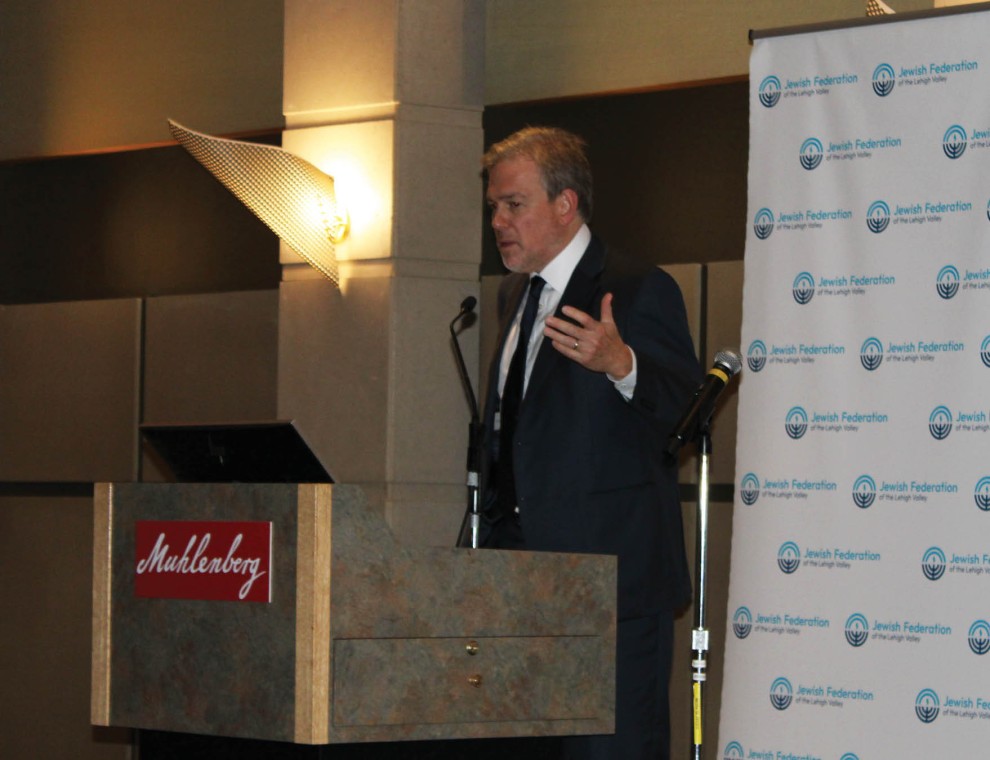
Set a realistic goal, Pulitzer Prize-winning New York Times columnist Bret Stephens told a Jewish community audience at Muhlenberg College on September 17. In your personal effort to help strengthen the Jewish community heading into the future, he said, if you shoot for, say, 50% improvement, you’re likely to feel overwhelmed and fail.
“My proposal is to be 10% Jewier,” he explained. “Wherever you are, add 10%.” If you currently direct 20% of your philanthropy to Jewish causes, he said, make it 30%.
Stephens, a Jewish columnist known for speaking his mind about the U.S. Jewish community and Israel, was in town for the kickoff event of the Jewish Federation of the Lehigh Valley’s 2027 Annual Campaign for Jewish Needs, to discuss the urgent topic “The Future of the Jewish Community in America.” Presented by the Jewish Federation with the generous support of Steven and Ann Marie Markowitz and Lew and Roberta Gaines, the event brought together the community’s major donors for dinner and to meet Stephens in person before it opened up to the entire community for Stephens’s featured presentation.
Stephens’s theme for the evening was the paradox of peak Jewish power versus declining Jewish influence in society. In light of that, he talked about the current challenges American Jews face and what they need to do meet them.
Most of the audience understood that his message would be critical yet constructive. As Federation president Bill Markson said in introducing him, “Bret is known for saying what needs to be said.”
Stephens offered three action points he believed were critical to creating a better future for America’s Jewish community. The first was, “Join intellectual battles against trends that tend to marginalize Jews.”
He explained that Jewish power was at a peak. While Jews make up just 2.4% of the U.S. population, 10 of 100 senators, six of 50 state governors, six of eight Ivy League presidents, 5 of 10 of the richest Americans are Jewish, all of which complemented a militarily and economically strong Israel. “We are as powerful as we’ve ever been in our history,” he said.
“Yet for all of this power,” he continued, “the trajectory of Jewish influence has moved in the opposite direction.” Jewish student enrollment at the Ivies has fallen from 20% to 7%, for example, while presence in the arts and cultural arenas has noticeably faded.
Meanwhile, verbal and other attacks on Jews and their place in society have increased. “Our influence is under sustained deliberate and intensifying assault,” Stephens said. “Part of that is antisemites masquerading as anti-Zionists”—foes of the Jewish people pretending that their negative words are simply critiques of Israel’s actions as a nation.
Another part is Jewish Americans not doing everything they can to alter this course. On college campuses, for example, Jewish leaders have promoted fairness. Overreach in that effort has led to weakened definitions of antisemitism, which permit more and more words and actions to pass through the filter as acceptable.
“What, if anything, can be done to stop this?” Stephens asked. He answered with his action point No. 2: “Jews need to once again learn how to convert their power to influence.” They need to aggressively re-enter the intellectual arena and fight against ideological trends seeking to marginalize them.
“Influential Jews are often reluctant to become Jewish influencers,” he said. That needs to change.
Action point No. 3 was “Invest Jewishly.” Noting his 10% rule, Stephens explained that Jews need to fund existing educational institutions like summer camps, affordable day schools, smaller Jewish communities, Jewish publishing imprints, and Jewish think tanks. Jewish media should become a training ground for young Jewish YouTubers and podcasters.
With more focused efforts and a wide-reaching commitment to being 10% Jewier, the American Jewish community can raise itself back to its previous heights of societal influence. “We cannot allow antisemitism to become the centralizing fact of Jewish life in the United States,” he said.
After Stephens finished his presentation, ticking off his lengthy list of problems, an audience member asked, “What gives you the greatest reason for hope?”
“Israel does,” he replied. “Although it’s a country like any other country,” he said, smiling, “Israel is maybe 10% better than other countries.”
He encouraged audience members to stand up for the Jewish community and Israel at this crucial time, even in the face of hatred and threats. “Be open and proud,” he said, like his mom, who lived through Holocaust and decided after the October 7, 2023, Hamas attacks to display the Israeli flag on the door of her home.
“I was born in hiding,” she told him. “I’m not going to live in hiding now.”
For guidance in doing your part for our Jewish community and to be 10% Jewier, contact Aaron Gorodzinsky, Jewish Federation director of development, at [email protected] or 610-8221-5500. As Gorodzinsky told the audience before they began leaving the event, “Seventy percent of everything you give stays in this community.”